Our partners at the Czech Hydrometeorological Institute (CHMI) attended an Acoustic Doppler Current Profiler (ADCP) workshop and field campaign on sediment transport in fluvial systems last month (18-19 March), which was held in Barcs located on the banks of River Drava, an area that forms a natural border between Croatia and Hungary. The event was organized in the framework of the Interreg Danube Sediment Q2 and Horizon INNO SED projects and provided a platform for method and technology development cooperation between Budapest University of Technology and Economics (BME), CHMI, University of Zagreb (UZ), Slovenian National Geological Survey (GeoZs), Hungarian National Water Directorate (OVF), and AquaTerra Ltd.
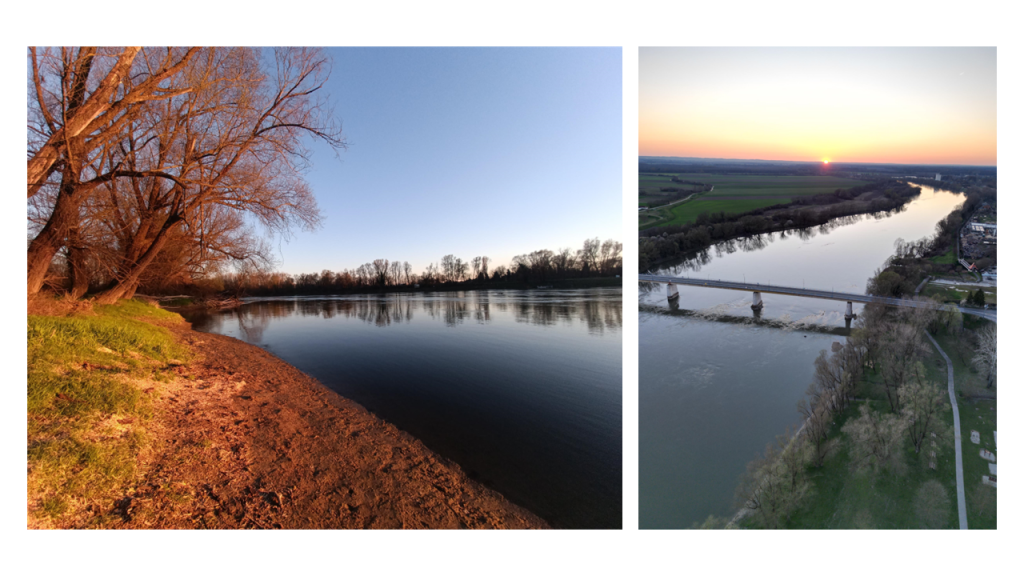
View of the River Drava (Image Credit: Libor Mikl - CHMI).
The main objective of the workshop and field exercise was to exchange expertise and experience among the participants, and to compare methodologies for sampling and quantitative measurement of suspended sediment using ADCP techniques, and thereby calibrating the Barcs Experimental Monitoring Platform measurements for the whole extent of the river cross-section. These instruments are commonly used for velocity and flow measurements in rivers and also allow the estimation of suspended sediment concentrations by the analysis of the intensity of the backscattered acoustic signal and the collected suspended sediment samples.
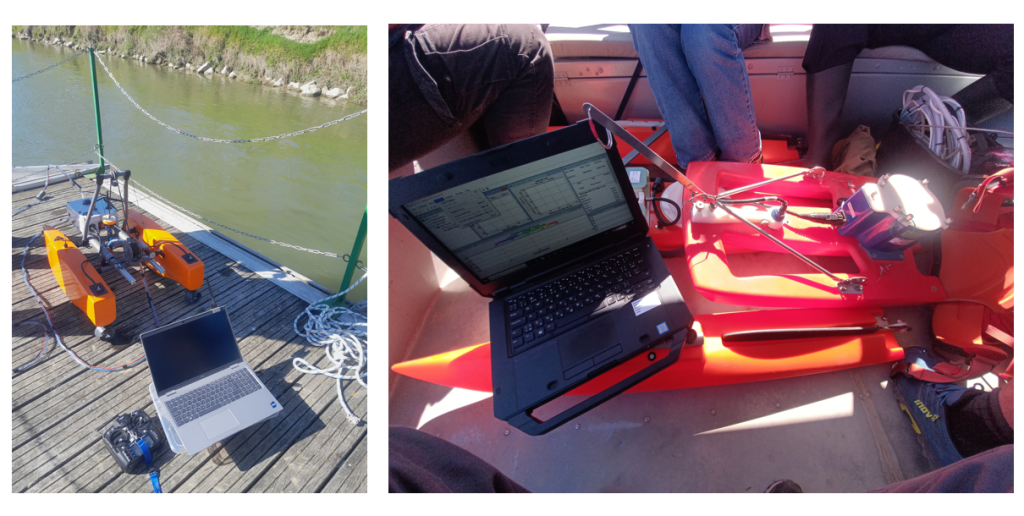
Technical set up for sampling and testing at the ADCP workshop long the River Drava (Image Credit: Libor Mikl - CHMI).
Monitoring sediment transport is essential for estimating the total transport of particle-bound pollutants, in addition to the assessment of river channel stability, water quality, protection of aquatic ecosystems, and flood risk prediction. Excessive sedimentation facilitates the transport of contaminants and can lead to siltation of reservoirs and negatively impact biodiversity, while a lack of sediment can lead to bank erosion and channel destabilization.
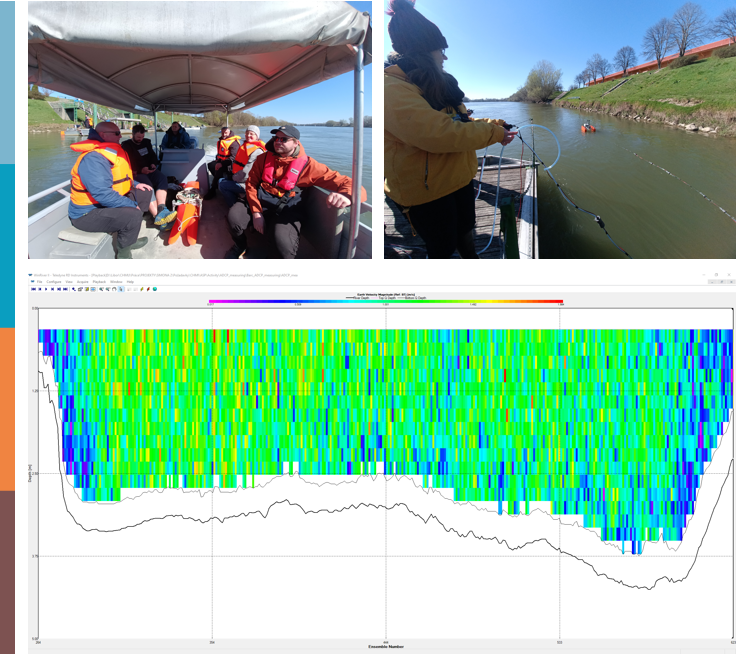
Workshop participants undertaking sampling assessments along the River Drava with some preliminary readings (Image Credit: Libor Mikl - CHMI).