
Lesson 3: Rivers
You likely have a good idea of what a river is.
The simplest explanation is that: rivers are basically water flowing through a landscape. But rivers aren’t just transportation ways for water; they bring many things along with them, including sediments.
Best of luck!
The river profile
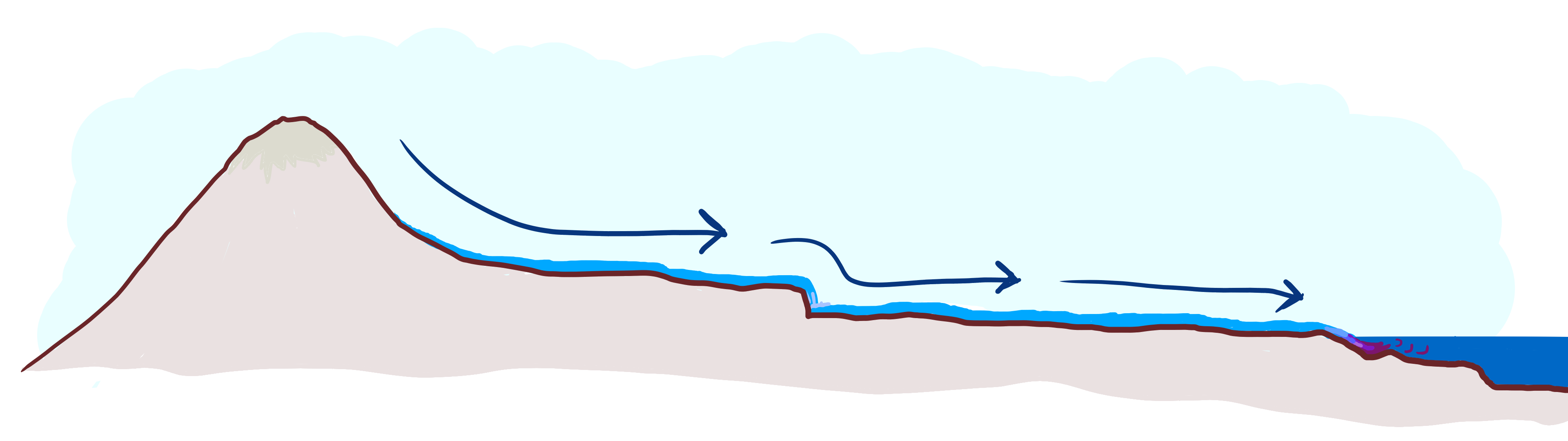
The overall flow in a river is driven by gravity. Rivers flow from higher elevations towards lower elevations; from the source towards the mouth. The part of the river closer to the source is called upstream, and the part closer to the mouth is called downstream.
When we study rivers, we often look at the river’s profile, which shows how the elevation of the river changes from its source to its mouth.
This illustration from earlier shows an example of a river profile:
Explore some of the features rivers can have in the picture below

Meanders: Where the river loses its linear path looking more like a snake.
Point bar: When a river bends, it deposits sediments on the inside of the bend.
Cut bank: When a river bends, it erodes sediments on the outside of the bend.
Oxbow lake: The bend of a river that has been cut off as the river changed. This results in a crescent-shaped lake.
Braiding: A river can split into smaller rivers or streams – forming islands in between. Further downstream they may randomly re-join or split into further smaller streams.
Riverbank: The shores of a river.
Tributary: Smaller rivers or streams joining the main river.
Confluence: The point where two rivers join into one river.
Rivers and sediments
One important thing: while rivers control the supply of sediments, sediments also control rivers!
Factors such as sediment grain size and the amount of sediment can change the overall path of a river dramatically. Moreover, the terrain that the river flows through has enormous influence on both the river and the sediments it carries.


As such, rivers depend on sediments, while sediments in turn depend on rivers. Much of the distribution of fluvial (meaning river-based) sediments on our planet is controlled by rivers and their properties: length, depth, width, shape and flow.
That means any changes in these properties along the river also change the sedimentary processes.
Energy and flow
In rivers, energy refers to how fast a certain amount of water moves through a river, which is strongly connected to its ability to move sediments.
In low–energy rivers, the river surface may appear smooth and unbroken – we call this laminar flow. In these conditions, sediments of smaller grain sizes can fall out of suspension, settle and thus become part of the riverbed.

However, in high energy rivers, the river surface often looks wavy and chaotic – this is turbulent flow. In such conditions, sediments of nearly all grain sizes, except the largest, are brought into, and can be kept in, suspension and are transported further downstream.

Changes in rivers
Rivers change constantly. While many of our planet’s processes take thousands or millions of years before we visibly see change, rivers can alter their shapes dramatically over a much shorter timeframe.
And therefore, sedimentary processes around river systems can change a lot over a shorter timescale. We’ve all seen images and videos of rivers swelling after heavy rain events as they flood cities and towns, including along the Danube River.
Such events can change much of a river profile permanently in mere hours. Therefore, rivers are highly influenced by extreme events like floods and droughts, and by our changing climate which changes the distribution and frequency of these extremes.
Moreover, a sudden release of sediments through landslides, human activities or storms can also yield very visible effects on a river over a short period of time.

Video showing the important role of erosion
Life in rivers
We’re not the only ones depending on rivers for resources, safety and transport. Large animals like sturgeons migrate upstream the Danube River as part of their lifecycle. Plants also thrive near rivers as they have a secure source of water.
We also depend on these organisms along and in rivers. Plants are essential in helping to stabilise riverbanks thereby reducing the rate of erosion. Animals in the Danube are vital sources of food for many people, while they also support the overall biodiversity and healthy ecosystems: which also benefit people.
